Speedrunning Browser Games: A Beginner's Guide
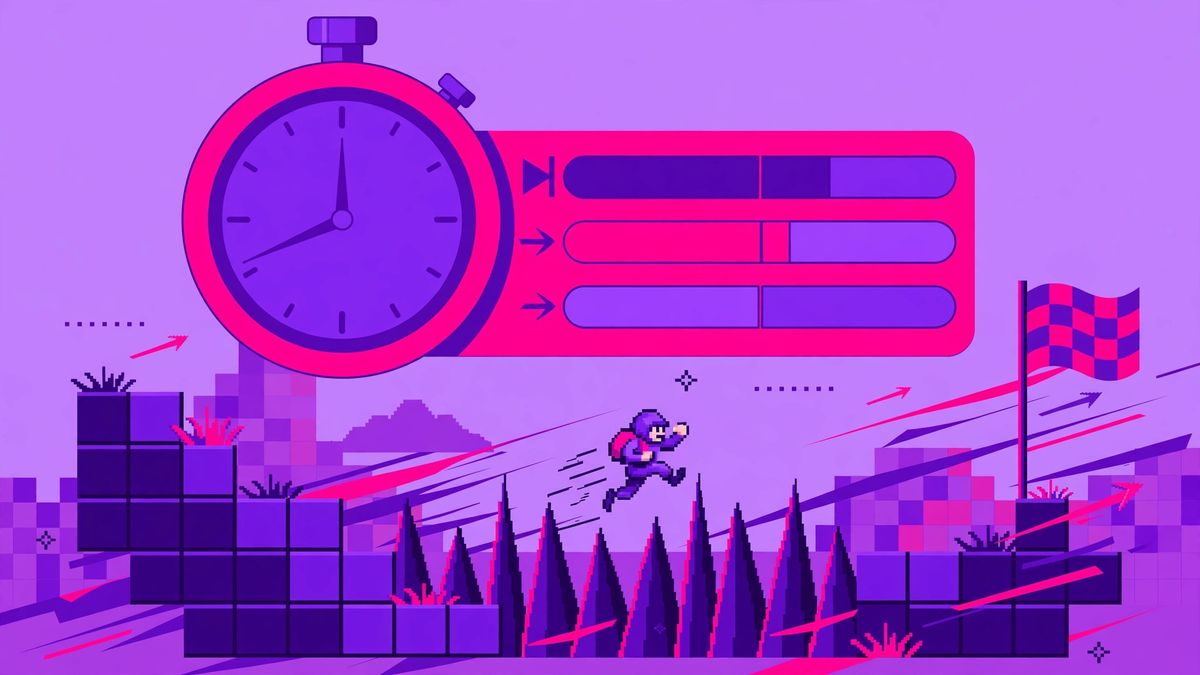
Short runs, free games, and a welcoming on-ramp to the hobby.
Somewhere right now, someone is finishing a free browser platformer in under four minutes — a game that took you an hour on your first try. That is speedrunning: playing games fast on purpose, measured to the frame, in the friendliest competitive scene in gaming. And the browser is the best place to start, because the two biggest barriers to the hobby — expensive games and long runs — simply do not exist here.
You do not need talent, reflexes of legend, or any special hardware. You need a game you like, a timer, and a week of curiosity. Here is what speedrunning actually is, how to pick your first game, and a concrete plan for your first seven days.
What speedrunning actually is
At its core, speedrunning is completing a game (or a defined goal within it) as fast as possible, with the run recorded and timed. Runs are organized into categories: any% means reaching the credits by any legitimate means, 100% means doing everything, and glitchless bans the weird tricks. Timing usually follows one of two conventions — real-time (wall clock from start to finish) or in-game time (the game's own clock) — and every leaderboard states its rules up front, so there is never ambiguity about what counts.
The part newcomers miss is that speedrunning is mostly a knowledge hobby, not a reflex hobby. The fastest players are not mashing buttons harder; they know exactly where to be, down to the pixel, because they have studied the game. A beginner who learns the route will beat a talented player who wings it, every single time. That is good news: knowledge is free, and it compounds.
Why browser games are the perfect start
Four reasons. Zero cost: the game is free, the timer is free, the recording software is free — the entire hobby costs nothing to try. Short runs: many browser games take five to fifteen minutes to complete, which means you can attempt a full run on a lunch break and practice a single segment in two minutes. Instant restarts: no loading screens, no console boot times; a failed run costs you seconds, not minutes, so you attempt far more runs per hour than console runners do. Welcoming communities: small browser-game leaderboards are usually maintained by enthusiasts who are delighted to see a new name — ask a question and you will often get the world-record holder as your personal coach.
Picking your first game
Your first speedgame matters more than your first run. Look for four traits. Short: under ten minutes for a competent run, so practice loops stay tight. Stable: minimal randomness — heavy RNG means your improvement gets drowned in luck, which is miserable for learning. A living leaderboard: even three active runners means routes have been worked out and questions get answered. A game you already enjoy: you are about to play it hundreds of times, so pick something whose company you like. A platformer or puzzle game you have already finished casually is ideal — you know the shape of it, and now you get to learn its secrets.
Avoid, for now: games longer than thirty minutes, games with frequent updates (patches can kill routes overnight), and anything where the top times require inhuman precision. You are building fundamentals, not chasing records yet.
Learning a route
A route is the planned sequence of actions for a run — where to go, what to skip, which tricks to use. Learning one is the heart of the hobby, and the method is straightforward. Watch a run first: find a top time on the leaderboard, watch it at half speed, and just absorb the shape of it. Take notes like a student: write down the order of levels, the key tricks, and anything that surprised you. Practice in segments: do not run the whole game yet — grind one section until it feels boring, then move to the next. Assemble slowly: once each segment is comfortable, start chaining them, two at a time, then three. Your first full runs will be messy and slow, and that is exactly right — a finished slow run teaches more than ten abandoned fast attempts.
One more tip: record everything from day one, even practice. Watching your own runs back reveals mistakes you cannot feel in the moment — a hesitation here, a suboptimal line there — and months later those early videos become a wonderful record of how far you came.
The basic toolkit
You need less gear than you think. A timer with splits is the one essential: it tracks your total time and compares each section against your best, so you always know whether you are ahead or behind. Splits turn a vague "that felt slow" into "I lost four seconds in the second half" — actionable data. A screen recorder (there are excellent free options) captures runs for submission and review. An input display — a small overlay showing your keypresses — is optional but genuinely useful for diagnosing mistakes. And a notes document: routes, trick timings, ideas to test. The whole toolkit is free, installs in minutes, and fits on the same machine already running your browser game.
Your first-week plan
Days 1–2: pick your game, watch two or three leaderboard runs, and write down the route in your own words. Do not time anything yet — just learn the shape. Days 3–4: practice the first third of the game in segments, no full runs. Get comfortable being bad at specific tricks; that discomfort is the feeling of learning. Day 5: practice the middle third the same way. Day 6: the final third, then your first full timed run — it will be slow, submit it anyway if the leaderboard takes beginner times (most do). Day 7: watch your run back, note the three biggest time losses, and pick one to grind next week. Congratulations: you are a speedrunner now. The rest is just iteration.
Etiquette: run clean
Speedrunning communities are small and trust-based, so the norms matter. No cheats, macros, or tool assistance unless the category explicitly allows them — a record built on a macro is worthless and will get you banned when discovered, which is always. Credit the discoverers: if you use someone else's route or trick, say so; route knowledge is community property built by real people's grinding. Submit honestly: include your video, follow the timing rules, and do not splice. And be kind in the forums: the person asking the "obvious" question today is next month's rival, and rivalries are the fun part.
Speedrunning a browser game will teach you something surprising: that mastery is mostly attention. Ten focused hours on a tiny free game will show you depths — pixel-perfect jumps, hidden shortcuts, rhythms you can feel in your hands — that a hundred casual hours never reveal. Pick a game, start the timer, and find out how deep the rabbit hole goes. It is free, it is short, and the community is waiting.
Editorial note: this page is original to arcade.nerdherald.com. Game genres are described by mechanics; any specific titles mentioned are illustrative examples, not endorsements. The site is non-adult and free of blank-click or history hijacking.